


Cash, Accrual, and the Messy Middle Nobody Admits They're In
.png)
One of the most common questions accountants ask is when a company should convert from cash basis to accrual.
It's a reasonable question. The answers usually aren't.
The usual ones point to a revenue threshold, an employee count, a transaction volume — some milestone where a company is supposedly no longer “small” and therefore must graduate into accrual accounting. Those explanations describe size, and size isn't what forces the change.
For most private companies in the United States, neither tax law nor GAAP automatically forces the conversion. Since the 2017 Tax Cuts and Jobs Act, the rules have grown markedly friendlier to cash basis — a business can stay on it for tax purposes as long as it falls under the gross-receipts threshold, which now sits around $30 million and adjusts for inflation each year. GAAP only enters the room when someone actually requires GAAP-compliant statements. So the real question was never whether a company can stay on cash basis.
It's whether anyone with leverage cares enough to make it stop.
That's what drives the transition. Not revenue. Not headcount. Not transaction volume.
Stakeholders.
Accounting Is a Language
Part of why this debate gets heated is that accountants treat accrual as though it were inherently superior — more sophisticated, more professional, more correct. But accounting isn't a competition for sophistication. It's communication. The purpose of a financial statement is not to satisfy the accountant who prepared it; it's to help someone make a decision. And different people need to make different decisions.
The owner of a $3 million, or $8 million, or even $15 million company is usually not preparing SEC filings. They're trying to answer a short list of questions. Did we make money? Do we have enough cash? Can we hire, can we survive a bad quarter, can we afford the new truck — and why is the bank balance lower than I expected?
Cash basis answers those questions remarkably well, and it answers them in the language management already speaks. Money came in, money went out, here's what's left. It isn't a complete picture — but it's an understandable one, and understandable is not a small thing. The moment the books become more complex than the people relying on them can follow, the accounting department stops analyzing the numbers and starts translating them. That translation is real work that never shows up on an invoice.
Cash Basis Is Better Than Accountants Like to Admit
Cash basis accounting gets framed as a phase. A company starts there, it grows, and eventually it becomes a “real” company and adopts accrual. The reality is far less dramatic.
Cash basis is simple. Everyday software supports it natively, the staff understand it, the owner understands it, the managers understand it. Recruiting is easy. Training is easy. The close is often faster, because the department isn't spending its month maintaining schedules, estimates, and reconciliations. Simplicity gets talked about like a weakness. In a lot of organizations, it's an operational advantage — and it scales much further than people think.
Watch what happens to the conversation when the basis changes. A founder reads a cash basis income statement and understands the story immediately: we collected $2 million, we spent $1.7 million, we made roughly $300,000. Not technically perfect — but understandable. The same founder reads an accrual statement and walks into a different room. Revenue now includes contracts that haven't been collected. The equipment purchase disappeared into fixed assets. The insurance payment no longer matches insurance expense. Deferred revenue pulled earnings down; amortization pulled profit down further, even though no cash left the building.
Now the controller has to explain the translation. Again, and again, and again — not because the owner is difficult, but because accrual accounting was never built to answer the question the owner is asking.
Cash basis asks: what happened to my money?
Accrual asks: what economic activity occurred, regardless of when the money moved?
Those are different questions. Neither is superior. They serve different audiences — and the trouble starts when a company can't say which question it's actually answering.
Accrual Accounting Is Not Free
Here is the part the maturity narrative leaves out. Accrual accounting carries a cost, and it isn't only the price of better software.
Every accrual policy you adopt creates future work. Capitalize fixed assets, and someone maintains a depreciation schedule from now on. Defer revenue, and someone maintains a waterfall. Amortize prepaids, and someone tracks benefit periods and monthly releases. A prepaid isn't just an asset; it's future work. A deferred revenue schedule isn't just compliance; it's future work. An accrual environment is a standing commitment to maintain an entire ecosystem of supporting schedules — forever.
It also raises the bar on who is qualified to do it. Accrual follows a codification with hundreds of rules, many of them matters of interpretation rather than arithmetic. That calls for a more experienced accountant — one who can not only apply the rules but explain the translation back to a team and to management. People at that level are harder to recruit and more expensive to keep. More schedules, more reconciliations, more month-end procedures, more judgment calls, more training, more documentation. None of it is free.
And the stakes are asymmetric. A cash-basis mistake usually distorts timing. An accrual mistake can land on revenue recognition, a debt covenant, an investor report, an audit conclusion, or a valuation in diligence. The more sophisticated the framework, the more it costs when it's wrong. That is a real reason to demand justification before signing up for it — not because complexity is bad, but because complexity you don't need is just risk you've volunteered for.
None of this is an argument to ignore accrual concepts. A project business, a SaaS company, a construction firm — any of them can make terrible decisions if management watches only cash. Choosing cash basis doesn't mean choosing ignorance. Good operators still track backlog, budgets, future obligations, and pipeline. Cash basis is a reporting method, not a substitute for management discipline. The argument isn't don't understand accrual. It's don't build a full accrual machine until you need one.
When Accrual Actually Matters
Most companies don't choose accrual. It gets chosen for them, and almost always by someone outside the accounting department.
The first trigger is usually a lender. A bank extending a larger credit facility wants accrual-based statements because it's evaluating the economic performance of the business, not just watching the cash balance. The second is governance: boards, private equity groups, and institutional investors expect accrual reporting because they need period-to-period consistency and comparability across what they hold. The third is an approaching transaction — a company expecting to be acquired, raise capital, or sit through real diligence should move toward accrual well before those conversations start, not during them.
Notice what isn't on that list. Revenue. Headcount. Number of transactions. A $20 million company can run cleanly on cash basis. A $3 million company can need accrual by next quarter because of a single covenant. Size isn't the determining factor. Who relies on the statements is.
You Can Run One Way and Report Another
Here's the option that rarely makes it into the conversation — and it's the one lean companies have quietly used for years.
Operating books and reporting books don't have to be the same books.
A company can run on cash or modified basis all year — because that's the language management thinks in — and engage a CPA firm to convert to accrual when an outside party requests it. CPA converts for the annual review. For the audit. For the lender package. For acquisition diligence. This is not a workaround; it's how a great many lean companies have always operated.
That reframes the whole question. Many companies don't need accrual books. They need accrual statements — and only at specific moments, for specific readers. The day-to-day ledger can stay in the language the operators understand, and the accrual version gets produced when, and only when, someone with leverage asks for it.
Once you see that distinction, the binary dissolves. You're not choosing cash or accrual for all time. You're choosing the simplest basis that runs the business, and producing the more complex one on demand.
The Messy Middle Nobody Admits They're In
Of course, reality rarely sorts itself into one bucket or the other. Most growing businesses are not purely cash basis, and they are not fully accrual either. They're somewhere in between, and they got there one reasonable decision at a time.
A company capitalizes fixed assets and records depreciation. It accrues the annual bonus. It defers revenue on annual contracts, amortizes prepaid insurance, carries an inventory balance — applying some accrual concepts and quietly skipping others. That's modified basis accounting, and there is nothing wrong with it. Controllers build exactly this every day, because accounting happens in the real world, where cost and benefit have to balance and nobody has time for the parts that don't earn their keep.
The problem was never modified basis. The problem is pretending it isn't modified basis.
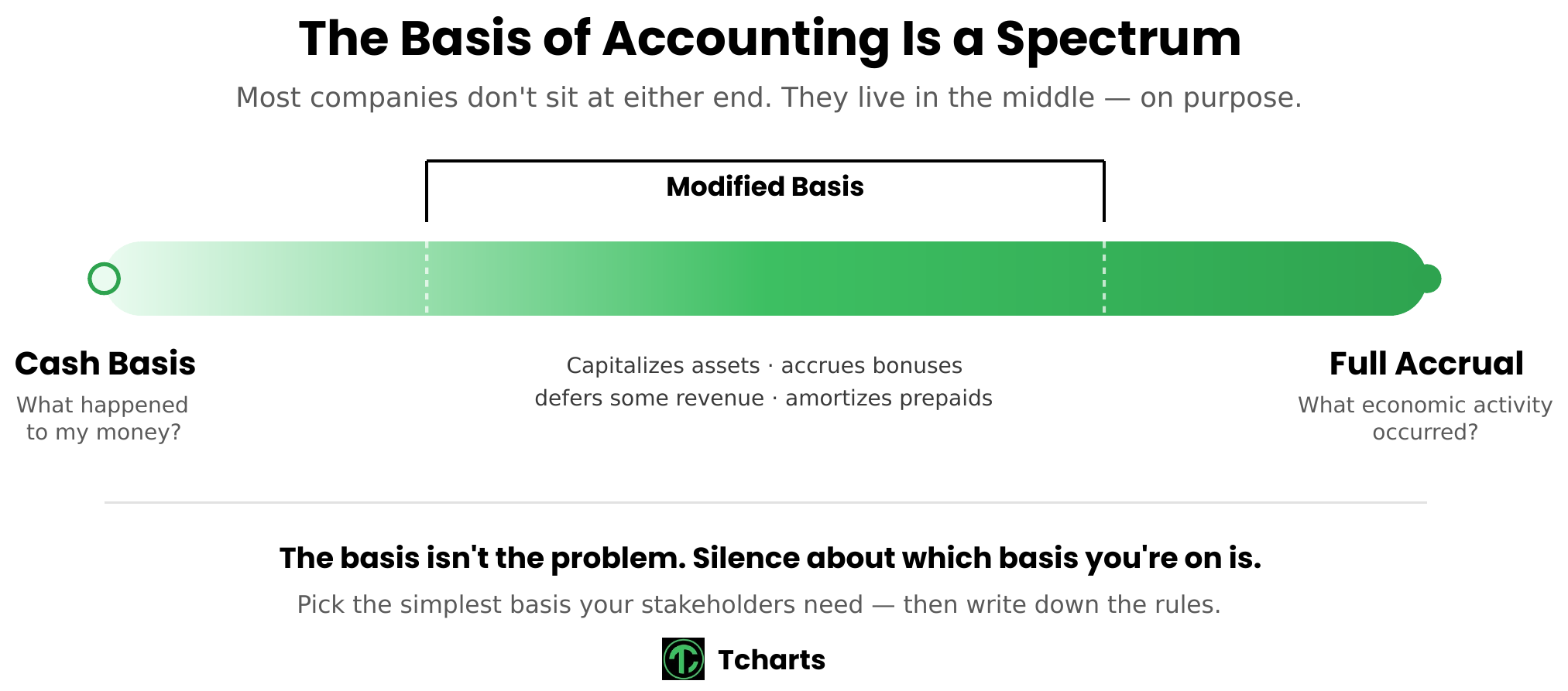
Modified Basis Isn't Wrong. Modified Basis Without Rules Is.
Modified-basis systems rarely fail because the accounting is inaccurate. They fail because no one wrote the rules down.
Ask three people in the department why a given policy exists and you'll often get three different answers. Ask when something should be capitalized. Ask when revenue should be deferred. Ask why one accrual gets recorded and a similar one doesn't. Eventually someone says, “that's just how we've always done it.”
At that point the method has stopped being a policy. It's institutional memory — and institutional memory is one resignation away from walking out the door.
If a company is going to operate on a modified basis, it should own the decision instead of backing into it. Define the basis of accounting and the specific modifications to it. Set materiality thresholds. Document the revenue recognition practices, the capitalization policy, and the judgment calls that shape the statements. Put it in an accounting policy guidebook, so the basis lives in a document rather than in one person's memory. And if those modified-basis statements ever go to an outside reader, label them honestly and disclose enough that the reader understands what they're holding. The goal isn't perfection. It's clarity.
Leave a Map
There is nothing wrong with cash basis. There is nothing wrong with accrual. There is nothing wrong with the modified basis living between them. Each can be exactly right, depending on the company's stakeholders, reporting requirements, and operational reality.
What creates problems is ambiguity. A company believes it's on cash basis while quietly running half a dozen accrual policies. A lender believes the statements are accrual-based while significant accounts sit on cash. A new controller inherits a month-end close built entirely on assumptions no one ever wrote down. In every one of those, the basis of accounting wasn't the failure. The silence around it was.
Most private companies should run on the simplest basis that satisfies the people relying on the numbers. For many, that's cash. When a lender, investor, board, auditor, or buyer eventually needs more, accrual becomes the sensible next step — and often it's a set of statements you produce for them, not a machine you have to run all year.
Until then — if you're going to live in the messy middle, and most companies do — leave a map behind explaining how you got there. The next person to open the books shouldn't have to guess.
