


.png)
You feel it before anyone says it. The close that used to wrap in a week now bleeds into the second. The backlog stops shrinking. Projects that mattered in January are still open in March. The team is short with each other, the managers are eating dinner at their desks, and the controller is clearing the inbox at eleven at night because that's the only hour the questions stop coming.
Then someone finally says it out loud.
We need another accountant.
Sometimes that's exactly right. Just as often, it's the most expensive wrong answer in the building.
Here's the problem. Overwhelm is real, and the strain is real, but neither one tells you what to do about it. Most organizations treat "we're overwhelmed" as a hiring diagnosis. It isn't a diagnosis at all. It's a symptom — and symptoms get diagnosed before they get treated, or you end up medicating the wrong illness.
Not All Overwhelm Is the Same
When a team says it's drowning, the instinct is to ask how many people it would take to keep them afloat. That's the wrong first question. The right one is quieter and far more useful: how are we drowning?
Because once you look closely, no two of them are alike. A team buried in transaction volume has a fundamentally different problem than a team buried in broken workflows — one needs hands, the other needs a redesign, and a new hire only fixes the first. A team that can't get decisions made doesn't need more accountants; it needs more authority. A team that can't think straight through the interruptions doesn't need headcount; it needs a wall around its calendar.
Every one of these situations produces the same two words. We're overwhelmed. And every one of them, left undiagnosed, gets "solved" the same lazy way — with a job posting.
That's not a diagnosis. It's the beginning of one.
The Six Types of Accounting Overwhelm
Strain in an accounting department almost always traces back to one of six sources. They look identical from the outside and demand completely different responses on the inside, which is exactly why so many hiring decisions miss.
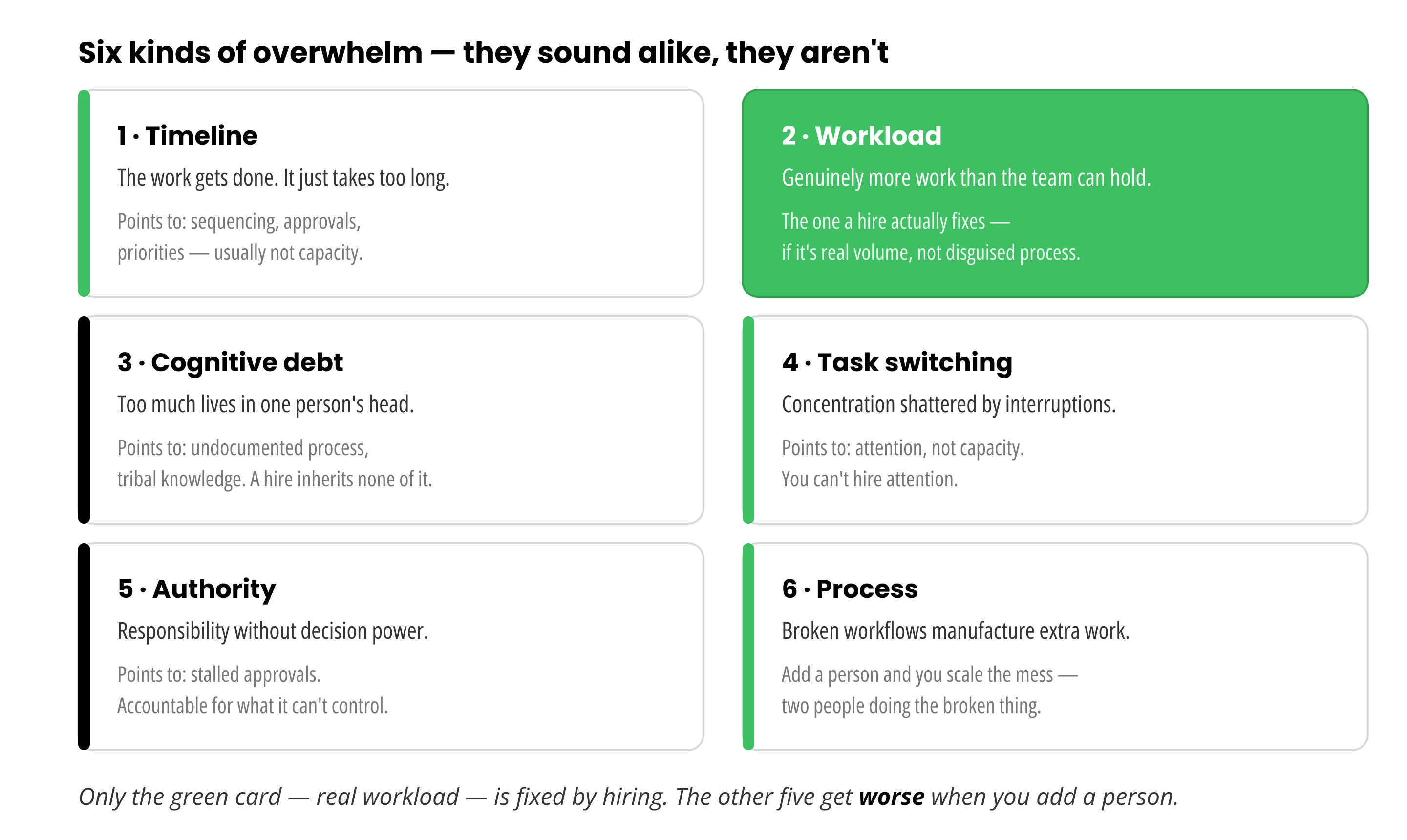
Timeline overwhelm. The work gets done. It just takes too long getting there. The close drifts from seven days to fifteen, reports land after the decisions they were meant to inform, and everything runs a half-step behind. The reflex is to blame capacity. The cause is usually sequencing — work happening in the wrong order, waiting on approvals that pile up, or starved of priorities that never got set. Adding a person to a badly sequenced close just gives you one more person waiting.
Workload overwhelm. Sometimes there is simply more work than the hours can hold: more invoices, more vendors, more reconciliations, more of everything. This is the one everybody reaches for first, because it's the one a hire actually fixes. But be honest before you post the job. Real volume and the appearance of volume look the same on a Tuesday afternoon, and plenty of "we need more hands" turns out to be three broken processes wearing a workload costume.
Cognitive debt overwhelm. The dangerous one, because it's invisible until someone takes vacation. Too much of how the department runs lives in one person's head. Nothing is written down, the knowledge is tribal, and the close depends on a single human remembering the sequence nobody documented. The team isn't slow because it lacks talent. It's slow because it spends its energy remembering instead of executing — and a new hire inherits none of that memory.
Task switching overwhelm. Accounting is concentration work, and concentration doesn't survive a department where the close competes with Slack, the audit competes with the close, and a "quick question" arrives every nine minutes. The work doesn't stop. It fragments — done in slivers, each one requiring a fresh mental run-up. The shortfall isn't capacity. It's attention, and you can't hire attention.
Authority overwhelm. Here the team owns the outcome but not the controls. The reconciliation is ready, the question is asked, the approval sits unanswered for a week — and accounting takes the blame for a delay it had no power to prevent. This is responsibility without a steering wheel, and no amount of headcount fixes a department that can execute but can't decide.
Process overwhelm. Broken workflows are factories for unnecessary work. The manual export that feeds the manual rekey that feeds the spreadsheet nobody trusts. The handoff that drops something every month. The two systems that were never introduced to each other. Drop a new hire into that machine and you don't relieve the strain — you scale it, because now two people are doing the broken thing instead of one.
Sometimes the Accounting Team Is Not the Problem
The most expensive assumption in this whole conversation is that the strain originates where it's felt. It usually doesn't.
More often, the company changed and accounting was simply the first place the change showed up. Revenue climbs from $5 million to $10 million. New leadership arrives wanting reporting the old reports were never built to produce. A lender adds covenant requirements. An acquisition lands. A compliance rule appears, a product line launches — and none of it happened in accounting, yet all of it lands on accounting's desk by the end of the month.
The team feels overwhelmed, and the team may be doing everything right — those aren't in tension. A flawless department feels a doubled workload just as sharply as a sloppy one. Miss that, and a company hires its way deeper into a problem a new accountant was never going to touch.
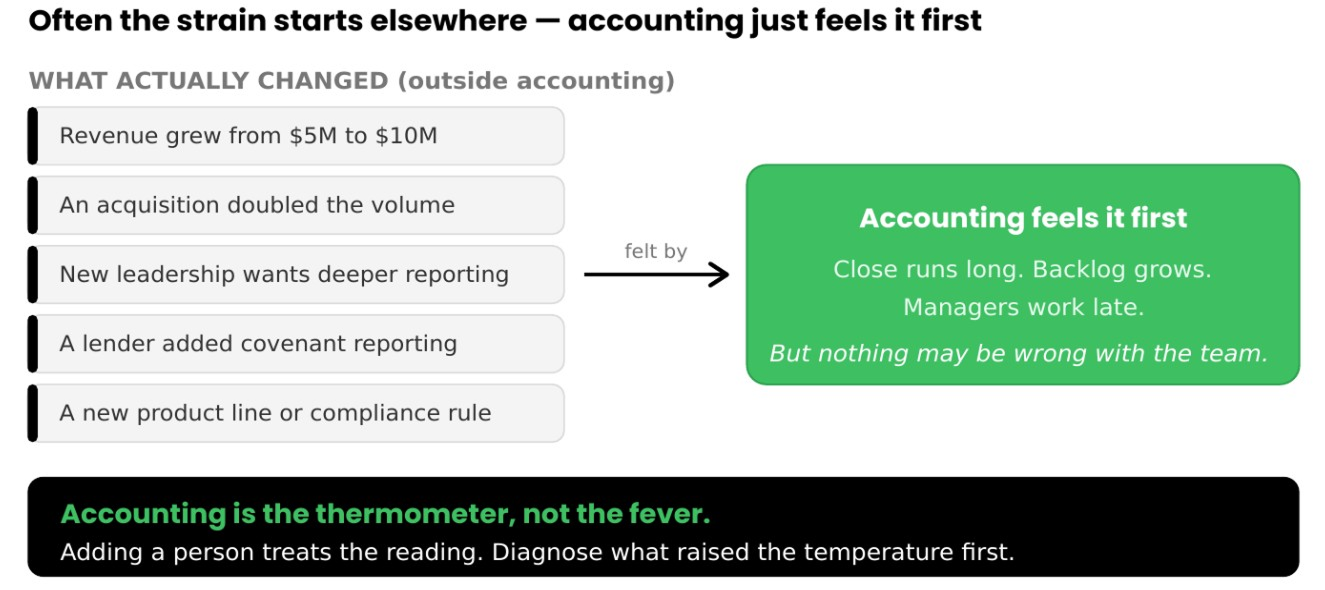
Accounting is often the thermometer.
Not the fever.
And you don't lower a fever by arguing with the thermometer.
Before Hiring, Exhaust Your Leverage
A new hire is one way to create capacity. It is rarely the cheapest, the fastest, or the first one worth trying — it's just the most obvious, which is a different thing entirely.
Before committing to a salary that recurs every year for as long as the person stays, it's worth asking whether the leverage already sitting in the building has been used. Is the accounting software actually doing what it was bought to do, or running at a fraction of its capability? Have the workflows been redesigned for how the business works now, or are they fossils from when it was half the size? Have the recurring tasks been automated, the reporting trimmed to what people actually read, the team trained on the tools they already own? Has anyone protected the calendar so focused work has somewhere to live? Has anyone actually found the bottleneck, or is everyone just certain there is one?
A genuinely surprising number of "we need to hire" problems dissolve the moment a systems problem gets solved — and they dissolve for a fraction of the cost.
None of this means hiring is wrong. It means hiring should be the conclusion of an investigation, not a substitute for one.
When a Hire Is Actually Necessary
And then there are the times when you've done all of that, and the answer is still yes.
The systems work. The software is earning its license. The team is trained, the workflows are clean, the calendar is defended. The business has genuinely grown, the volume is genuinely real, and the strain shows up in numbers you can point to rather than feelings you can sense. The team isn't disorganized. It's outnumbered.
That's when hiring stops being avoidance and becomes the right call.
But most organizations stop the analysis right here, too soon. Deciding that you need to hire and deciding what to hire are two separate decisions, and getting the first one right buys you nothing if you fumble the second.
Solve the Constraint, Not the Symptom
Picture a company that doubles overnight through acquisition. Transaction volume doubles. Reconciliations double. Invoices, vendors, the whole ledger — doubled. The need for capacity isn't in question.
So what gets hired?
More often than it should, the search starts at the top. A manager. A director. Another layer of leadership, because growth feels like it should be met with seniority.
But seniority isn't the constraint. Throughput is. The work that doubled was execution work, and execution is what's now underwater — which means the hire that relieves it is a staff accountant or a senior accountant, someone whose hands are on the ledger, not someone whose calendar is full of meetings about the ledger. Hire the layer of leadership and you've added cost above a bottleneck without widening it. The reconciliations are still late. You've just got someone more expensive to explain why.
Match the hire to the constraint. Not to the title someone on the team has been hoping to justify.
One Strong Senior, or Two Staff Accountants?
This is the question that actually keeps accounting leaders up, and it's a good one, because the obvious math is the wrong math. Two staff accountants cost about what one strong senior does, so the instinct is to take the two — more hands, more coverage, more flexibility.
Sometimes that's right. If the company is heading into real growth — more acquisitions, more entities, more expansion — then two accountants give you room to distribute work, shift responsibilities, and scale alongside the business in a way a single hire can't.
But junior talent arrives as potential, not finished capacity. It needs coaching, training, review, and a path — and all of that is time, drawn from someone who has to have it to give. If the controller's days already disappear into meetings, audits, budgets, and executive discussions, then supervision becomes the new bottleneck, and two staff accountants who can't get reviewed aren't capacity at all — they're slow capacity, work that arrives unfinished and waits on a controller who has no time to finish it. In that house, one senior who needs no babysitting is worth more than two juniors who do.
The decision isn't really about salary. It's about whether the organization has the capacity to carry what it hires — and a hire the department can't support isn't leverage. It's dead weight.
Hiring Is a Systems Decision
Most leaders file hiring under budgeting. Accounting leaders should file it somewhere more demanding.
Hiring is a systems decision, because a person is never just a person. Every hire reshapes the workflows around them, the communication lines through them, the review structures above them, and the management load on whoever owns them. One headcount changes the shape of the entire department, this year and for years after.
Which is why the goal was never to minimize headcount, and never to maximize it. The goal is an accounting function that supports the business accurately, sustainably, and without depending on any one person staying late forever. Sometimes that takes another hire. Sometimes it takes better software, or stronger training, or a leader willing to make decisions faster. The hard part — the part that separates good accounting leaders from the rest — is reading the situation correctly before the money is spent.
Final Thoughts
"We need another person" is not a conclusion. It's the opening line of an investigation, and how an organization responds to it reveals how seriously it takes its own accounting function.
The strongest leaders don't start with a job posting. They start with a diagnosis. They find where the strain is truly originating, they figure out what changed to cause it, and they wring every bit of leverage out of what they already have. Only then, with the evidence in hand, do they decide whether a hire is the answer.
Because the two outcomes look nothing alike. A necessary hire creates capacity the business can feel for years. An unnecessary one creates overhead it pays for just as long — a salary defending a problem that was never about staffing in the first place.
Good accounting leaders know the difference. The best ones build the framework that finds it before the job posting ever goes out.
